🏆 Bot Club, $9/mo: new copy-paste bot recipes and ready-made templates every month, plus a monthly “get unstuck” Q&A post in the members area. Cancel anytime.
Join Bot ClubWhy this is worth 20 minutes
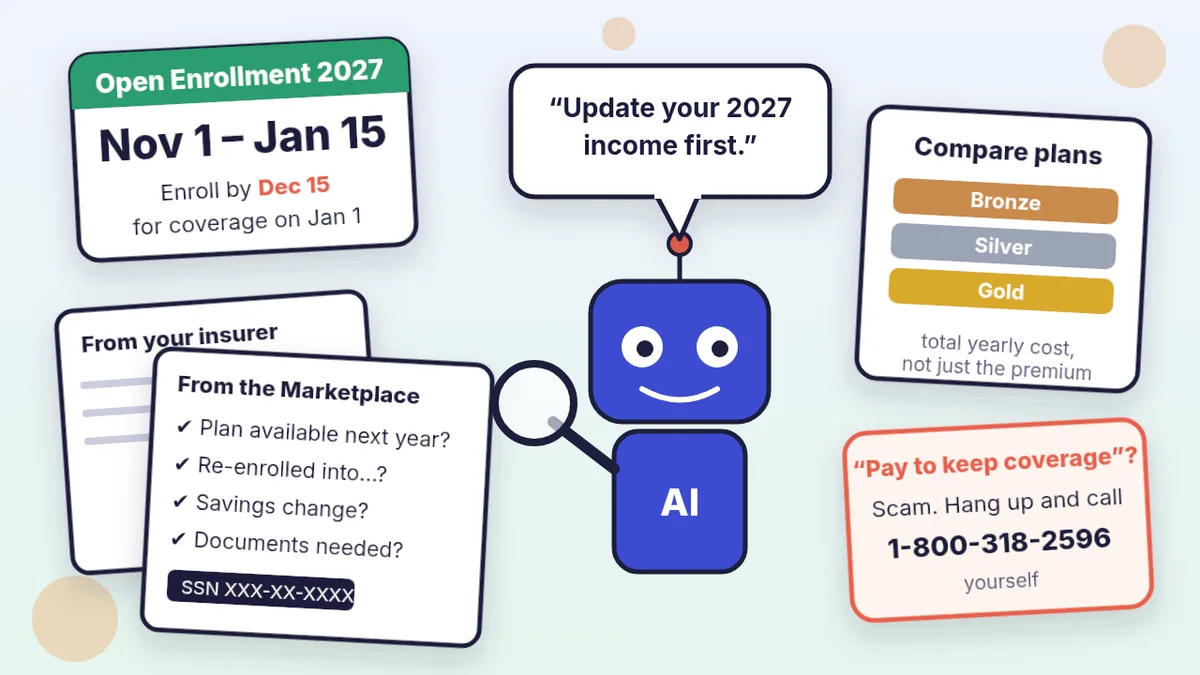
HealthCare.gov says plans and prices change every year, your situation may have changed too, and that your savings are based on your expected income for the year you want coverage, not last year. If you don’t update your income and household information, you could get less savings than you qualify for, or too much and have to pay back the difference when you file your federal taxes. The hard part is the paperwork: two letters full of words like “premium tax credit,” “deductible” and “re-enrollment,” plus a pile of ads. ChatGPT is good at exactly that kind of reading and list-making. You paste or photograph the pages (numbers covered) and it hands back a short list: what’s changing, what to update and what to ask.
The dates and rules (from HealthCare.gov)
Checked Oct 27, 2026, on HealthCare.gov. Give these to ChatGPT so it plans around them instead of guessing.
- November 1: Open Enrollment starts. HealthCare.gov says that starting November 1 you can apply for 2027 coverage or update your application with changes you expect for the year ahead.
- December 15: last day to enroll in or change plans for coverage to start January 1 (you also need to pay your first premium).
- January 15: Open Enrollment ends. Enroll or change plans December 16 to January 15 and coverage starts February 1. After that you can only enroll or change plans if you qualify for a Special Enrollment Period (life changes like moving, losing other coverage, getting married or having a baby).
- Already have a Marketplace plan? HealthCare.gov says that by November 1 you should get 2 letters, one from your insurance company and one from the Marketplace. Together they tell you if your plan is available next year, which plan you’d be automatically re-enrolled in if you don’t act by December 15, changes in your coverage and savings, and whether the Marketplace needs documents from you.
- Doing nothing isn’t always safe. If you don’t act by December 15 you may be automatically re-enrolled for January 1, but HealthCare.gov says you should still update your application to get the right savings, and in some cases you won’t be re-enrolled.
- Medicaid and CHIP: you can apply any time of year, not just during Open Enrollment.
- Your state may use its own site. HealthCare.gov says how you apply depends on whether your state has its own Marketplace; its “Marketplace in your state” page sends you to the right place (for example, Oregon residents use ExploreHealthOR.gov for 2027 coverage). Job-based plans can have different Open Enrollment dates; check with your employer.
- On Medicare? This isn’t your season’s guide. See Medicare Open Enrollment with ChatGPT (October 15 to December 7).
🧰 Want the shortcut? Get the Starter Kit ($29)
Everything from our guides in one download: a 2-minute “pick your assistant” chart, step-by-step setup checklists for ChatGPT Projects, Claude Projects and agent-style assistants, 24 copy-paste bot recipes (personal and small business), a safety and permissions checklist, and troubleshooting fixes. Includes a ZIP of every recipe as a ready-to-paste text file.
Get the Starter Kit: $29 See what’s inside →
One-time payment, secure checkout by Stripe, instant download page right after checkout.
Step 1: Gather your papers (10 minutes)
HealthCare.gov’s “Get Ready to Apply for or Re-Enroll” checklist (PDF) lists what to have ready. The short version:
- Your two Open Enrollment letters, if you already have a Marketplace plan.
- Everyone in your household, even people not applying: usually you, your spouse, and anyone you claim as a tax dependent. Home and mailing addresses.
- How you’ll file taxes (single, married filing jointly or separately) and who you’ll claim as dependents.
- Income for everyone in the household: pay stubs or W-2s, tips, self-employment income, unemployment, Social Security (including disability, but not SSI), retirement or pension income, investment and rental income. HealthCare.gov says you can start from your household’s adjusted gross income (IRS Form 1040, line 11) and update it for expected changes.
- Information about any job-based insurance someone in the household was offered, even if they didn’t take it.
- Before any photo or paste, cover Social Security Numbers, policy and member IDs, application IDs and account numbers with a sticky note. ChatGPT doesn’t need them to explain a letter.
3 copy-paste prompts to try today
1. 📬 Explain my Open Enrollment letters
I buy my own health insurance through the Marketplace.
Here are the two letters I got for next year, one from
my insurance company and one from the Marketplace (my
SSN, IDs and account numbers are covered):
[PASTE TEXT OR ATTACH PHOTOS]
1. In plain English: Is my current plan available next
   year? Which plan will I be automatically re-enrolled
   in if I do nothing by December 15?
2. Make a table: Topic | This year | Next year | Which
   letter and page says this. Include monthly premium,
   savings (premium tax credit), deductible, doctors or
   network changes, and anything else that changes.
3. Does either letter ask me to send documents? List
   exactly what and by when.
4. Don't guess. If something isn't in the letters, write
   NOT IN LETTER and add it to a list of questions.
Use short sentences and simple words.
Check every number in its table against the letters themselves. If it names a page, turn to that page.
2. 💵 Organize my 2027 income and household for the application
Help me get ready to update my HealthCare.gov
application for 2027 coverage. Savings are based on
my EXPECTED income for 2027, not last year.
- People in my tax household: [E.G. ME, SPOUSE, 2 KIDS]
- Last year's adjusted gross income (Form 1040, line
  11): [AMOUNT, OR "DON'T KNOW"]
- What I expect to change in 2027: [E.G. NEW JOB, FEWER
  HOURS, SIDE GIG, RETIRING, A KID MOVING OUT]
- Income types we have: [WAGES / TIPS / SELF-EMPLOYED /
  UNEMPLOYMENT / SOCIAL SECURITY / PENSION / OTHER]
1. Put this into a simple table: Person | Income type |
   Expected 2027 amount | Where the number comes from.
2. Mark anything I still need to look up with [CHECK].
3. List the changes I should report on my application.
Don't calculate my tax credit or tell me what I'll pay;
HealthCare.gov does that. Just help me organize.
Then use HealthCare.gov’s own income calculator for your best estimate. HealthCare.gov notes that 2027 income levels and savings arrive on November 1; before then, its estimates use 2026 amounts.
3. 📞 My questions before I call for free help
I'm going to call [THE MARKETPLACE CALL CENTER / A
LOCAL ASSISTER / MY INSURANCE COMPANY] about Open
Enrollment for 2027 coverage. I want coverage to start
January 1, so my deadline is December 15. My situation:
[NEW TO THE MARKETPLACE / ALREADY ENROLLED], and I'm
worried about [E.G. MY PREMIUM GOING UP, MY DOCTOR
LEAVING THE NETWORK, MY INCOME CHANGING].
1. Write my 8 most important questions, most important
   first, in plain words.
2. Add a short "have in front of me" list (no numbers
   typed here; I'll read them off my papers).
3. Leave space under each question for the answer, the
   person's first name and the date.
Don't answer the questions yourself.
HealthCare.gov lists two kinds of free, Marketplace-certified local help: assisters (also called navigators), who are required to give fair, impartial and accurate information, and agents and brokers, who are generally paid by the insurance companies whose plans they sell and may not sell every company’s plans. Use HealthCare.gov’s Find Local Help directory, or call the Marketplace Call Center at 1-800-318-2596 (TTY 1-855-889-4325), which HealthCare.gov says is open 24 hours a day, 7 days a week.
🔒 Members-only
Members get the full pack: 12 more HealthCare.gov Open Enrollment prompts + a fill-in “2027 Open Enrollment card”
Copy-paste prompts for the rest of the season: compare plans side by side from your own HealthCare.gov notes, a Bronze/Silver/Gold “total yearly cost” worksheet, an “is this call or ad a scam?” check, a December 15 countdown plan, a doctor and drug network check list, a plain-English insurance word explainer, a “which changes do I report?” check, a self-employed income worksheet, help a parent or adult child with permission, a document-request reply checklist, a one-page decision note, and a January to-do list. Plus a fill-in 2027 Open Enrollment card.
Bot Club · $9/mo · cancel anytime. Your Member Library opens right after checkout.
Join Bot Club, unlock the full pack · $9/moStep 2: Compare plans on HealthCare.gov
- Preview first. You can preview plans and prices at HealthCare.gov/see-plans, but exact prices and savings come when you fill out the application.
- The “metal levels” are about cost sharing, not quality. HealthCare.gov says Bronze, Silver, Gold and Platinum have nothing to do with the quality of care. On average the plan pays about 60% (Bronze), 70% (Silver), 80% (Gold) or 90% (Platinum) of covered costs and you pay the rest; Bronze generally has a high deductible.
- Silver can be special. If you qualify for extra savings (cost-sharing reductions), HealthCare.gov says you only get them if you enroll in a Silver plan.
- Catastrophic plans are a fifth category, if available in your area, for people under 30 or who qualify for a hardship or affordability exemption.
- Think total yearly cost, not just the premium. HealthCare.gov suggests comparing what you’d spend on care across plan categories. Ask ChatGPT to help with the math from your own notes (members’ worksheet above), never from its own guesses.
Step 3: Enroll, then pay your first premium
- Apply or update your application on HealthCare.gov (or your state’s site), then pick a plan.
- Coverage only starts after you pay your first premium, and you pay premiums directly to the plan, not to anyone else.
- Income too high for savings? HealthCare.gov says you can still apply through the Marketplace, or buy from an insurance company, an agent or broker, or an online seller.
- During the year, report changes like a new job offer with insurance, a move, marriage, a birth or a big income change as soon as possible; they can change your savings.
Scam check: “HealthCare.gov” calling?
- HealthCare.gov says scammers may email, text or come to your home uninvited claiming to be from the Marketplace, and warns about health insurance ads on social media offering cash, gifts or other perks.
- Don’t give money (credit card, gift cards, cash, prepaid debit cards or cryptocurrency) to anyone who says you must pay them to keep or apply for coverage.
- Real Marketplace calls come from 1-855-997-1890 or 844-477-7500 (caller ID “Health Insurance MP” or “InsMarketplace”), and they won’t ask for your bank or account numbers or health history. Unsure? Hang up and call 1-800-318-2596 yourself.
- Report suspected fraud to the Federal Trade Commission, your local police and the Marketplace Call Center, HealthCare.gov says. More red flags: understand bills, letters and forms (and spot scams).
Privacy tips
- Cover Social Security Numbers, member and application IDs, and account numbers before any paste or photo.
- Use a Temporary chat in ChatGPT for this, and don’t save health or income details to memory. See control what ChatGPT remembers.
- Only share another person’s information (a spouse, parent or adult child) with their permission.
- More in Is my AI assistant safe?
Troubleshooting
- “It gave me a dollar amount for my savings.” Ignore it. Ask again with “Don’t calculate; just organize,” and use HealthCare.gov’s calculator and application for real numbers.
- “It says my plan renews automatically.” Maybe, maybe not. Check your Marketplace letter; HealthCare.gov says some people won’t be re-enrolled.
- I didn’t get my letters. HealthCare.gov says to contact your plan for the insurance company letter and the Marketplace Call Center for the Marketplace letter.
- The photo is blurry or cut off. Retake it flat, in good light, one page at a time, or paste the text instead.
- My state isn’t on HealthCare.gov. Use HealthCare.gov’s “Marketplace in your state” page to find your state’s site and its dates.
Why Bot Club is only $9 a month
This guide gives you the first three Open Enrollment prompts free. Bot Club is for having the right prompt ready the moment you need it: the 12 extra prompts above (side-by-side plan compare, total yearly cost worksheet, scam check, December 15 countdown, doctor and drug network check, insurance words explained, which changes to report, self-employed income worksheet, helping a parent, “send documents” letter checklist, one-page decision note and January to-do list) and the fill-in 2027 Open Enrollment card, plus every other members-only pack (Medicare, bills and paperwork, budgeting and more) in one Member Library, and a new recipe each month. Cancel anytime from your Stripe receipt.
Want it done faster?
🧰 Starter Kit: $29
24 copy-paste bot recipes, setup checklists and a safety checklist, with a ZIP of every recipe as a text file.
Get the Starter Kit: $29🏆 Bot Club: $9/month
The 12 Open Enrollment prompts and 2027 Open Enrollment card above, every other members-only pack, and a new recipe every month. Cancel anytime.
Join Bot Club: $9/mo🛠️ Done-for-you setup
$199 setup + $49/month. Want an AI assistant set up for your business and tested on your real everyday tasks? We build it with you, then keep it tuned every month.
Get set up: $199Not sure which assistant fits you? Take the 2-minute AI sidekick quiz.
Study Buddy Engineer is independent and is not affiliated with HealthCare.gov, the Centers for Medicare & Medicaid Services (CMS), any state Marketplace, any insurance company, or OpenAI. Health Insurance Marketplace® is a registered trademark of the Department of Health & Human Services. Dates, rules and savings can change, so check HealthCare.gov or your state’s Marketplace for the latest. This guide is general information, not insurance, tax, legal or medical advice.
Sources
- HealthCare.gov: When can you get health insurance? (dates and deadlines) (checked Oct 27, 2026)
- HealthCare.gov: Keep or change your insurance plan (checked Oct 27, 2026)
- HealthCare.gov: Get Ready to Apply for or Re-Enroll in Your Marketplace Coverage (checklist PDF) (checked Oct 27, 2026)
- HealthCare.gov: Saving money on health insurance (checked Oct 27, 2026)
- HealthCare.gov: Health plan categories (checked Oct 27, 2026)
- HealthCare.gov: Get help applying (checked Oct 27, 2026)
- HealthCare.gov: Protect yourself from Marketplace fraud & scams (checked Oct 27, 2026)
- HealthCare.gov: Which changes to report (checked Oct 27, 2026)
- HealthCare.gov: Special Enrollment Periods (checked Oct 27, 2026)
- HealthCare.gov: If your income is too high for the premium tax credit (checked Oct 27, 2026)
- HealthCare.gov: How to use Form 1095-A (checked Oct 27, 2026)
- HealthCare.gov: The Marketplace in your state (checked Oct 27, 2026)
Keep going: related guides
- Understand bills, letters and forms
- Make a simple monthly budget
- Medicare Open Enrollment with ChatGPT
- Upload a photo or PDF safely
🎁 Free: 10 copy-paste ChatGPT prompts
Ten short copy-paste prompts from our free guides, each with a Copy button:
- Reply to a customer review (good or bad)
- A week of social posts in 5 minutes
- Match your resume to one job posting
- Practice the interview out loud
- “Use up my fridge” dinners
- A “tight week” budget dinner plan
- Fill in your “trip card”
- Plan a road trip like a human
- “Explain it like I’m 10”
- “Grade my answer, don’t write it”
Free with an email signup. We never sell your email.
Pick the easiest way to get going
Three simple options. Secure checkout by Stripe.
🧰 Starter Kit
- Pick-your-assistant chart
- Setup checklists
- 24 copy-paste bot recipes
- Safety checklist + troubleshooting
🏆 Bot Club
- New bot recipes every month
- Ready-made templates
- Monthly “get unstuck” Q&A in the members area
- Cancel anytime
🛠️ Done-for-you setup
- We set up your assistant with you
- Monthly tuning: fixes, updates
- New recipes as you go
📬 Get one fun bot trick every week
The Bot Whisperer newsletter: free, plain English, unsubscribe anytime.
Coming soon: sign-ups open shortly. Follow @teachbots to hear when they do.