🏆 Bot Club, $9/mo: new copy-paste bot recipes and ready-made templates every month, plus a monthly “get unstuck” Q&A post in the members area. Cancel anytime.
Join Bot ClubFirst, the honest part
Search “make money with ChatGPT” and you’ll find screenshots of big monthly numbers and courses promising passive income. Here’s what the FTC says about offers like that: if a business offer or coaching program promises guaranteed income, large returns, or a “proven system,” it’s likely a scam, and no one can guarantee that you’ll make money in business.
So this guide won’t give you an income number. Nobody can honestly promise one. What we can give you is a realistic, low-cost way to test whether you can earn with AI skills: one small service, one real customer, done well.
🧰 Want the shortcut? Get the Starter Kit ($29)
Everything from our guides in one download: a 2-minute “pick your assistant” chart, step-by-step setup checklists for ChatGPT Projects, Claude Projects and agent-style assistants, 24 copy-paste bot recipes (personal and small business), a safety and permissions checklist, and troubleshooting fixes. Includes a ZIP of every recipe as a ready-to-paste text file.
Get the Starter Kit: $29 See what’s inside →
One-time payment, secure checkout by Stripe, instant download page right after checkout.
What actually sells: results, not “AI”
A busy shop owner doesn’t want to buy “AI.” They want their Google reviews answered, their questions handled and their social page not to look abandoned. If you can hand them that, done and checked, you have something to sell. AI is how you do it faster; your judgment is why they trust you with it.
Start with businesses you already know: where you get your hair cut, your car fixed, your coffee, your dog groomed. You understand their customers, and they already know your face.
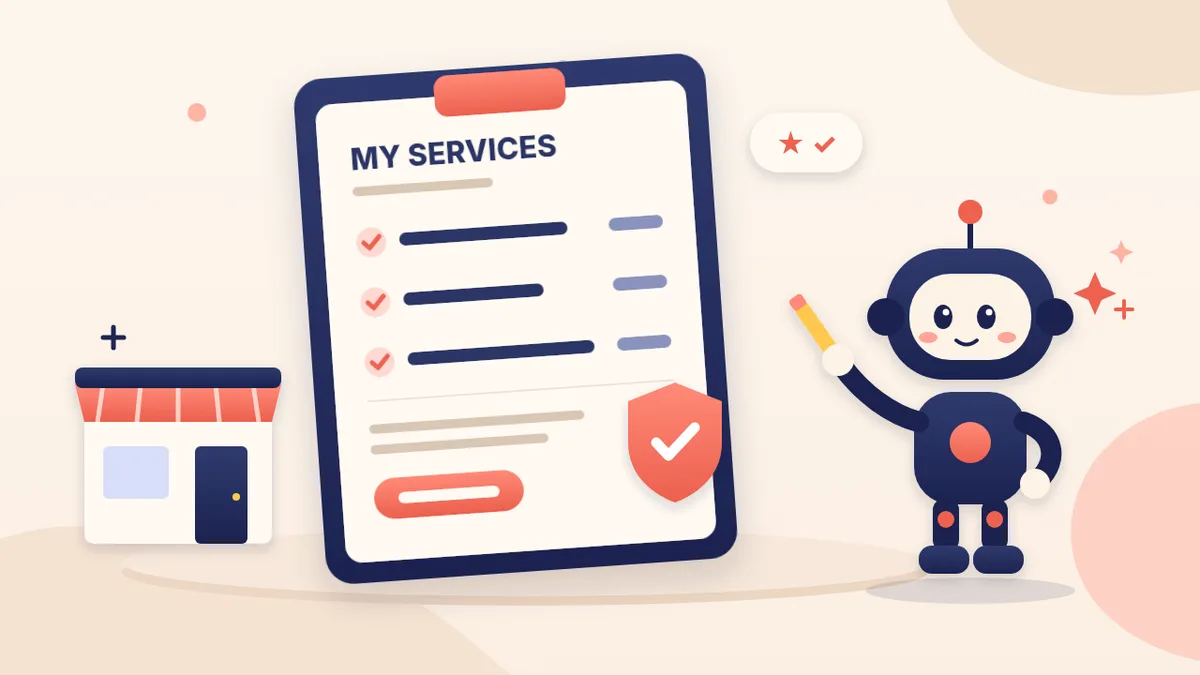
6 beginner-friendly services local businesses already need
Each one has a free step-by-step guide on this site, so you can practice on your own (or a friend’s) business first.
⭐ Review-reply drafts
You draft replies to their Google reviews in the owner’s voice; the owner approves and posts them. Learn it: reply to Google reviews with ChatGPT.
💬 Customer FAQ helper
Turn their hours, prices and policies into a one-page FAQ and a helper that drafts answers from it. Learn it: make an AI FAQ bot.
📱 A month of social posts
Draft posts in their voice from real photos and real news, for the owner to approve. Learn it: social posts that don’t sound like ads.
🧾 Quote and estimate templates
Set up a quote template and a Project that uses only their price list. Learn it: write quotes and estimates with ChatGPT.
✉️ Customer email templates
Booking confirmations, “running late”, invoice reminders, all in their tone. Learn it: write emails with ChatGPT.
📁 “Set up my AI” sessions
Sit with the owner and build a ChatGPT or Claude Project with their files and rules, so they use it themselves. Learn it: ChatGPT Projects for beginners.
Notice what’s not on the list: fake reviews, fake testimonials, “guaranteed” rankings or legal advice. More on why below.
The rules that keep you honest (from OpenAI’s own terms)
- You own what you make. OpenAI’s Terms of Use say that, as between you and OpenAI and to the extent the law allows, you own the Output. They also say output may not be unique: other people can get similar text, so add the business’s real details.
- Don’t pass AI off as human. The same terms say you may not represent Output as human-generated when it wasn’t. Easy fix: tell clients you use AI tools and that you personally check every word.
- Check everything. OpenAI says output may not always be accurate and that you must evaluate it, including with human review, before using or sharing it. That checking is part of what the client pays you for.
How to price without guessing (or hype)
We won’t tell you what to charge, because it depends on your town, the work and your skill, and nobody honest can promise what you’ll earn. Here’s how to set a price you can defend:
- Price a finished result, not your minutes. “Replies to this month’s reviews” or “a 10-question FAQ and helper” is easier to say yes to than an hourly rate.
- Write what’s included and not included. Number of posts, rounds of changes, how fast you reply. Our quote guide has prompts for exactly this.
- Look up what’s already out there. Check what local freelancers and agencies publicly list for similar work, and ask a couple of owners what they pay now. Don’t ask AI to make up a “market rate”; it can’t know your town.
- Start small and fixed. One small starter job is less risk for both of you. If they like it, offer the same thing monthly.
- Do the math before you quit anything. The FTC suggests asking of any business idea: How would it generate income? What would my expenses be, and can I afford it? When would I expect to turn a profit? Ask those about your own plan too, including your AI subscription.
Step 1: Pick your first service (5 minutes)
Paste this into ChatGPT, Claude or Grok Bot:
1. 🧭 Find my best first service
I want to earn some extra money offering simple AI-assisted
services to local small businesses. About me: [YOUR JOB, SKILLS,
HOBBIES, HOURS PER WEEK, PHONE OR COMPUTER]. Businesses I know
personally: [LIST 3-5].
Interview me with 5 short questions, one at a time. Then suggest
the ONE service I should try first, why it fits me, exactly what
I'd deliver, and what I'd need from the owner. No income
estimates, no hype. Be honest if something isn't a good fit.
Step 2: Make a free sample (the best pitch there is)
Owners say yes to something they can see. Make a small sample using only information the business has already made public, like their website or their public reviews.
2. 🎁 Build a sample for a real business
Here's public info about [BUSINESS NAME], a [TYPE OF BUSINESS]
in [TOWN]: [PASTE THEIR HOURS, SERVICES, AND 3 PUBLIC REVIEWS].
Make a short sample I can show the owner:
- replies to the 3 reviews in a warm, local, human tone
- 5 FAQ answers based ONLY on the info above
Where you'd need info I don't have, write [ASK OWNER] instead
of guessing. Don't invent prices, hours, policies or promises.
Check it line by line before you show anyone. A sample with a made-up price or policy loses you the client.
Step 3: Send a short, honest pitch
3. ✉️ Write my first pitch
Write a short message (under 100 words) from me to the owner of
[BUSINESS], whom I know as a customer. Offer [SERVICE] and say I
made a free sample they can keep, attached. Mention that I use AI
tools and check every word myself. One clear next step: [e.g.
"Want me to do this month's reviews?"]. Friendly, plain, no hype,
no fake urgency, no claims about results I can't guarantee.
Send it the way you’d normally talk to them: in person, by text, or by email. Then follow up once, kindly, a few days later. No reply is an answer too.
🔒 Members-only
Members get the full pack: 12 more client-finding and pitch prompts + a one-page service menu template
Copy-paste prompts for the rest of getting and keeping a first client: a list of 20 local businesses to approach and why, a polite follow-up when they don’t reply, 6 questions for a 15-minute discovery chat, a clear scope with what’s included and not, a reply to “can’t I just use ChatGPT myself?”, a calm reply to “that’s too much”, a new-client onboarding checklist, a one-page monthly report, an honest feedback request that doesn’t script their words, a short before-and-after case study using only real results, a referral ask, and a kind way to turn down work you can’t do well. Plus a fill-in one-page service menu template.
Bot Club · $9/mo · cancel anytime. Your Member Library opens right after checkout.
Join Bot Club, unlock the full pack · $9/moHow to spot a “make money with AI” scam
This matters. As the FTC puts it, many people would like to make money working from home, and scammers know this. The FTC’s warning signs, in plain English:
- Guaranteed income, big returns or a “proven system.” The FTC says that’s likely a scam. Its examples of false lines include “You can make 5-6 figures if you follow our system” and “You can be making money now. Guaranteed!”
- Pressure to buy now. Scammers push you to get involved now or risk losing out. The FTC’s rule of thumb: an offer that’s good today should be good tomorrow, too.
- Glowing success stories. The FTC says testimonials might not be true or typical, and positive reviews may come from made-up profiles.
- The upsell. If the coach asks for even more money to help your business succeed, the FTC says stop, hang up and talk to someone you trust.
- Pay to get the job. For work-from-home offers, the FTC warns about paying for starter kits, “training” or certifications that turn out to be useless, and says honest employers won’t ask you to pay to get a job.
- A check you deposit and partly send back. That’s a fake check scam, per the FTC. Walk away.
“AI-powered” doesn’t make it real. In 2024 the FTC announced Operation AI Comply, including cases against schemes that claimed AI tools would help people earn money through online storefronts. In one, the FTC alleges Ascend Ecom falsely claimed its AI-powered tools would help consumers quickly earn thousands of dollars a month in passive income and defrauded consumers of at least $25 million. (The FTC said that case was ongoing.) The announcement quoted Chair Lina M. Khan: “The FTC’s enforcement actions make clear that there is no AI exemption from the laws on the books.”
Before you pay for any business opportunity: the FTC says to ask for the legally required one-page disclosure document. It must identify the seller, tell you about lawsuits, explain any cancellation or refund policy, give you references and, if they make a claim about how much you can earn, come with an earnings claim statement. If what they say contradicts that document, steer clear. Also search the company name with “review,” “scam” or “complaint,” check with your state attorney general, and talk it over with someone you trust. Report scams at ReportFraud.ftc.gov.
Don’t become the scam
- Never write fake reviews or testimonials, even if a client asks. In the same sweep, the FTC took action against an AI writing tool over its review and testimonial generator, saying the reviews it produced would almost certainly be false for the people who posted them.
- Don’t promise results you can’t control, like rankings, sales or “more customers by Friday.” Promise the work: what you’ll deliver and when.
- Don’t sell AI as a professional. The FTC acted against a company that called its AI service “the world’s first robot lawyer.” Keep your services to drafting and setup, and send legal, tax or medical questions to a licensed pro.
- Protect their customers’ privacy. Use first names in AI chats and keep phone numbers, addresses and payment details out.
Common beginner mistakes
- Selling “AI” instead of a result. Lead with “I’ll answer your reviews every month,” not “I do AI.”
- Offering ten services. Get really good at one, then add a second.
- Skipping the check. One wrong price or hour in a client’s FAQ costs you more than the job pays.
- Buying a course first. Free official help pages and practice on your own business go a long way. Read any paid offer against the FTC signs above.
- No proof. Do one sample, ask for honest feedback, and keep a simple before-and-after (with permission).
Looking for a regular AI-related job instead? See ChatGPT for job search and our honest AI careers starter path.
Why Bot Club is only $9 a month
Every guide here gives you the first working win for free. Bot Club is for the part that takes the longest: the full, tested prompt packs and templates, so you skip the trial and error. For a side hustle that means the client-finding prompts, the service menu template and the packs behind every service above (reviews, FAQ helpers, social posts, quotes, emails) in one Member Library, plus a new recipe each month, for one small monthly price. Cancel anytime from your Stripe receipt.
Want it done faster?
🧰 Starter Kit: $29
24 copy-paste bot recipes (including the Review Reply Writer, Shop FAQ Helper and Price Quote Helper), setup checklists and a safety checklist, with a ZIP of every recipe as a text file.
Get the Starter Kit: $29🏆 Bot Club: $9/month
The 12 client-finding and pitch prompts and service menu template above, every other members-only pack, and a new recipe every month. Cancel anytime.
Join Bot Club: $9/mo🛠️ Done-for-you setup
$199 setup + $49/month. Rather have a working assistant for your own business first? We build it with you, test it on real tasks, then keep it tuned every month.
Get set up: $199Not sure which assistant fits you? Take the 2-minute AI sidekick quiz.
Selling your own stuff is the fastest place to start. Our guide to write resale listings with ChatGPT covers eBay, Vinted, Facebook Marketplace and Poshmark: honest titles and descriptions from your photos, pricing from real sold listings, and the buyer scams to watch for.
Sources
- FTC Consumer Advice: When a Business Offer or Coaching Program Is a Scam (checked Oct 22, 2026)
- FTC Consumer Alert: How to spot and avoid business coaching scams (checked Oct 22, 2026)
- FTC Consumer Alert: Vetting a business or coaching opportunity before you buy in (checked Oct 22, 2026)
- FTC Consumer Advice: Job Scams (checked Oct 22, 2026)
- FTC press release: FTC Announces Crackdown on Deceptive AI Claims and Schemes (Operation AI Comply) (checked Oct 22, 2026)
- OpenAI Terms of Use (effective Jan 1, 2026; checked Oct 22, 2026)
🎁 Free: 10 copy-paste ChatGPT prompts
If this guide helped, these two free small-business prompts pair well with it, with a Copy button:
- Reply to a customer review (good or bad)
- A week of social posts in 5 minutes
The pack also has 8 more copy-paste prompts from our other free guides (job search, meals, trips, study and small business).
Free with an email signup. We never sell your email.
Pick the easiest way to get going
Three simple options. Secure checkout by Stripe.
🧰 Starter Kit
- Pick-your-assistant chart
- Setup checklists
- 24 copy-paste bot recipes
- Safety checklist + troubleshooting
🏆 Bot Club
- New bot recipes every month
- Ready-made templates
- Monthly “get unstuck” Q&A in the members area
- Cancel anytime
🛠️ Done-for-you setup
- We set up your assistant with you
- Monthly tuning: fixes, updates
- New recipes as you go
📬 Get one fun bot trick every week
The Bot Whisperer newsletter: free, plain English, unsubscribe anytime.
Coming soon: sign-ups open shortly. Follow @teachbots to hear when they do.