🏆 Bot Club, $9/mo: new copy-paste bot recipes and ready-made templates every month, plus a monthly “get unstuck” Q&A post in the members area. Cancel anytime.
Join Bot ClubWhy this matters right now
Holiday shopping season means lots of real delivery texts, and lots of fake ones. The U.S. Postal Inspection Service warns about “smishing” (scam text messages) that say a USPS package needs your response and include a strange link. And on September 17, 2026 the FBI said its Internet Crime Complaint Center received nearly 61,000 complaints of law enforcement or government impersonation scams between January 2025 and July 2026, with reported losses of more than $1.6 billion.
Scams also got harder to spot. CISA (the U.S. cybersecurity agency) says bad grammar used to be a clue, but with AI some scam emails now have perfect grammar and spelling. The FBI warns that scammers use AI-generated video and cloned voices that can sound “nearly identical” to someone you know. So the old “it looked professional” test doesn’t work anymore. A calm second opinion and a quick real-world check do.
The red flags the FBI, CISA and USPIS say to look for
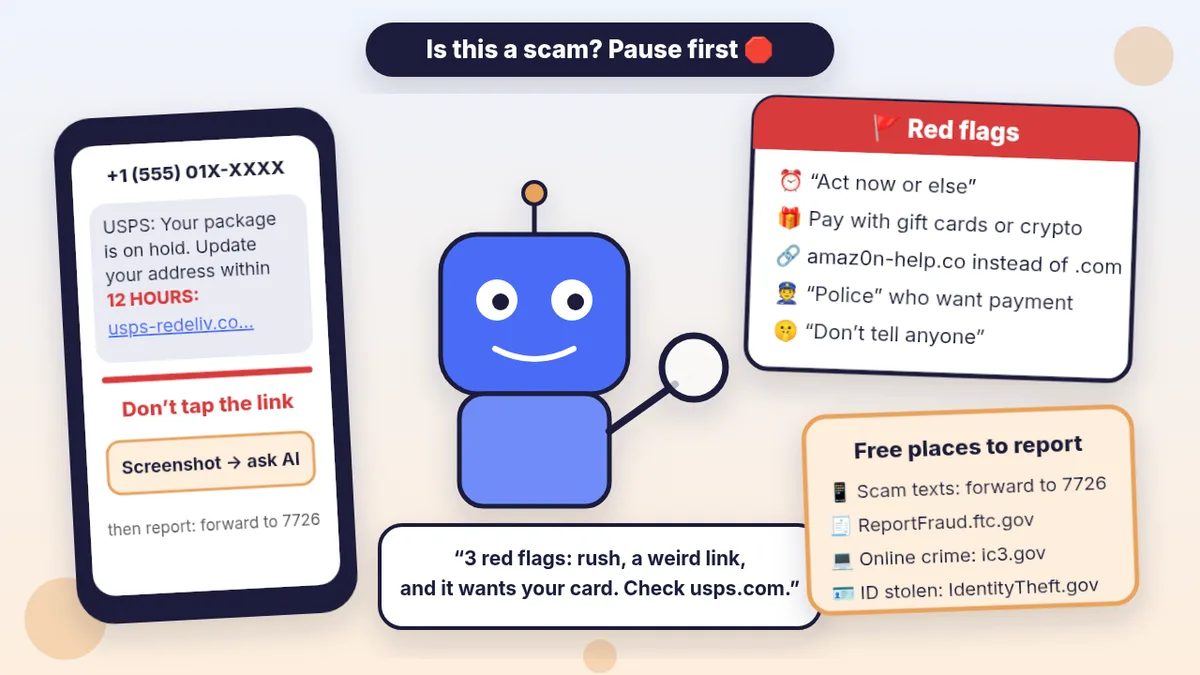
- Hurry or fear. CISA lists “urgent or emotionally appealing language,” especially threats of “dire consequences” if you don’t act right away. The FBI says impersonators use urgent, aggressive tones and may try to keep you on the phone the whole time or tell you not to talk to anyone else.
- Asking for your personal or money details. CISA lists requests for personal and financial information as a top sign. USPIS says smishing texts are after things like usernames and passwords, your Social Security number, date of birth, card numbers and PINs.
- A web address or email that’s almost right. CISA’s example is a fake like “amaz a n.com.” The FBI says scam links may closely mirror official ones with slight changes, or end in .com instead of .gov.
- Paying in a strange way. The FBI says law enforcement and government officials will never request payment by prepaid cards, cryptocurrency or courier. USA.gov says imposters try to get you to send money or a gift card.
- “Government” contact out of the blue. USA.gov says that unless you contacted them first, government agencies typically reach you by letter, so unexpected contact by other means may be a scam. It also warns scammers can fake caller ID to look like an official number.
- Package texts with a link. USPIS says USPS will not send you texts or emails without you first requesting tracking with a tracking number, and those messages will not contain a link. Expecting a package? Go to USPS.com yourself.
- A “grandchild” or relative in trouble. USA.gov describes “grandparent” scams where someone pretends to be a younger relative who needs emergency money.
- Someone offering to get your lost money back. The FBI says the IC3 never contacts people directly and doesn’t work with law firms or crypto services to recover money; “recovery” offers are a way to scam people a second time.
- Fast, flattering new “friends.” The FBI warns about “love bombing,” where a stranger showers you with attention and then brings up investing, often in cryptocurrency, sometimes with a courier sent to pick up cash.
🧰 Want the shortcut? Get the Starter Kit ($29)
Everything from our guides in one download: a 2-minute “pick your assistant” chart, step-by-step setup checklists for ChatGPT Projects, Claude Projects and agent-style assistants, 24 copy-paste bot recipes (personal and small business), a safety and permissions checklist, and troubleshooting fixes. Includes a ZIP of every recipe as a ready-to-paste text file.
Get the Starter Kit: $29 See what’s inside →
One-time payment, secure checkout by Stripe, instant download page right after checkout.
Step 1: Pause. Don’t click, reply or call back
CISA’s advice for a suspicious message is simple: don’t reply, and don’t click any link or attachment, including any “unsubscribe” link. If you think it might be real, CISA says not to use any link or phone number in the message; look up another way to contact the company or person yourself. That’s what the prompts below help with.
3 copy-paste prompts to try today
1. 🔍 “Is this a scam?” second opinion
Paste this into a new chat, then paste the message (or attach your screenshot) underneath.
I got the message below and I'm not sure if it's
a scam. I have NOT clicked anything. Please:
1. List every red flag you see (rush or threats,
   a link or sender address that looks off, a
   request for personal info, codes or payment by
   gift card, crypto, wire or courier).
2. List anything that looks normal.
3. Give a verdict: Likely scam / Not sure /
   Probably real, with a one-line reason.
4. Tell me the SAFE way to check: what to look up
   myself (official website or the number on my
   card or statement). Never tell me to use the
   link or number in the message.
Keep it short and in plain English.
Message: [PASTE TEXT OR ATTACH SCREENSHOT]
Even if ChatGPT says “probably real,” still check the safe way before you log in or pay. If you’re helping a parent, you can run this for them from a photo they send you.
2. ☎️ Phone call check and a polite hang-up script
Use this right after a call (or a voicemail) that made you nervous.
I just got a call from someone who said they were
[THE BANK / POLICE / A GRANDCHILD / TECH SUPPORT /
A GOVERNMENT AGENCY]. Here's what they said and
asked for: [DESCRIBE IT. DON'T INCLUDE ACCOUNT
NUMBERS, CODES OR MY SSN].
Please:
1. Tell me which parts match common scam tricks.
2. Write a short, polite script I can say next
   time: "I'll call you back on the official
   number," then hang up.
3. Tell me exactly how to find the official number
   myself (back of my card, a statement, the
   agency's .gov website), not from the caller.
4. Give me 2 questions only the real person would
   know, if they said they were family.
The FBI’s advice matches this: don’t give personal information until you’ve verified who someone is, and use official, publicly available contact information, not the contact details the caller gives you.
3. 📝 Turn it into a report (in 2 minutes)
Reporting helps stop the next person from getting fooled. This prompt organizes the facts so the form is easy.
Help me report a scam attempt. Here are the facts:
- How they contacted me: [text / email / call /
  social media / pop-up]
- Who they said they were: [__]
- Their phone number, email, website or profile
  name: [__]
- What they asked for: [__]
- Did I click, pay or share anything? [no / yes:
  what, when, how much]
Please:
1. Write a clear, short summary in time order.
2. Tell me which of these fits: forwarding a scam
   text to 7726, ReportFraud.ftc.gov, the FBI's
   ic3.gov, spam@uspis.gov (USPS texts) or
   IdentityTheft.gov.
3. Make a checklist of screenshots and records to
   keep. Don't ask me for passwords or full
   account numbers.
🔒 Members-only
Members get the full pack: 12 more scam-check prompts + a fill-in “Our Family Scam Plan” card
Copy-paste prompts for the tricky ones: an email sender and link check, a “grandchild in trouble” call, a “government says I owe” message, a Black Friday store check before you buy, a Marketplace buyer or seller payment check, a job or side-gig offer, a too-friendly online contact who mentions investing, a computer pop-up, a voicemail or AI voice, a “we can recover your money” offer, an after-I-clicked action plan and a 10-minute monthly account check. Plus a fill-in Our Family Scam Plan card for the fridge.
Bot Club · $9/mo · cancel anytime. Your Member Library opens right after checkout.
Join Bot Club, unlock the full pack · $9/moStep 2: Check the real way
- Go around the message. CISA says to get the company’s contact information from its verified website: search for it or type the address yourself. For your bank or card, use the number on the back of the card or your statement.
- Packages: USPIS says that if you’re expecting a parcel, don’t click the link; visit USPS.com yourself to track it. The same idea works for other carriers and stores: open their app or type their website.
- A friend or relative: CISA suggests using another way to reach them. If a strange message comes from a friend on Facebook and you have their phone number, call or text them to ask.
- “Police” or “government”: the FBI says to ask for credentials and then contact the agency using official, publicly available information, never the contact information the caller gives you.
- Video calls aren’t proof. The FBI says scammers can use AI to appear as officials on video calls, and to clone voices. Hang up and call back on a number you already trust.
Step 3: Report it (it’s free and takes minutes)
- Scam texts: forward the text to 7726 (USPIS says this helps report the scam phone number), then delete it.
- Fake USPS texts: USPIS asks you to email spam@uspis.gov: copy the text (without clicking the link) into a new email, add your name and a screenshot showing the sender’s number and date, and say whether you clicked, lost money or shared information.
- Scams and bad business practices: report to the FTC at ReportFraud.ftc.gov.
- Online and cyber-enabled crime: the FBI’s ic3.gov is its central hub for reports; the FBI says to file even if you’re unsure your complaint qualifies. Age 60 or over and need help filing? The FBI points to the DOJ Elder Justice Hotline, 1-833-FRAUD-11 (833-372-8311).
- Not sure where? USA.gov has a free where to report a scam tool that asks a few questions (about 1 to 2 minutes) and points you to the right agency.
- Phishing email: CISA says to use the “report spam” or report option in your email app, then delete it.
Already clicked, paid or shared? Do this now
- Stop all contact with the scammer (FBI).
- Call your bank or card company using the number on your card. USPIS says to notify your financial institution if you interacted with a scam link at all, even if you didn’t press submit.
- Report it to your local police and to ic3.gov, the FBI says, with the scammer’s phone numbers, emails, web addresses, payment details and messages. Keep your financial records and messages.
- If your personal information was stolen, USA.gov says to report it at IdentityTheft.gov or 1-877-438-4338, ask the three major credit reporting agencies about a fraud alert and credit freeze, and contact the fraud departments at your bank and card issuers.
- Watch for “recovery” scams. The FBI says the IC3 will never contact you directly for information or money, and anyone on social media offering to get your money back for a fee is a scammer.
Use free prompt 3 above to organize your report, or members’ prompt 14 for a full action plan. Feeling embarrassed? Don’t be: the FBI says “you are not alone,” and reporting protects other people.
Cut down on scam calls and texts
- Block text-by-email spam: USPIS suggests calling your carrier’s customer service (usually 611) and asking it to block text and picture messages sent to you as email; you may also be able to turn these blocks on in your online account.
- Do Not Call Registry: the CFPB suggests adding your number to the free National Do Not Call Registry at DoNotCall.gov. (It stops many sales calls; scammers ignore it, so the red flags above still matter.)
- Lock your accounts: CISA recommends strong passwords, a password manager, multifactor authentication and installing software updates without delay.
- Worried about an older relative? The CFPB says to contact your local adult protective services agency if an older person or a person with a disability may be a victim of financial exploitation. A simple family plan (the fill-in card for members above) helps a lot.
Privacy: what to share with ChatGPT
Share the message, not your secrets. It’s fine to paste the scam text, the sender’s number and the web address typed out. Don’t paste passwords, one-time codes, PINs, full card or bank numbers, or your Social Security number, and cover your name and address in screenshots. Want fewer chats saved? See ChatGPT Memory and Temporary Chat and our Is my AI assistant safe? guide.
Troubleshooting
- ChatGPT says it’s “probably real,” but I’m still uneasy. Trust your gut. Check the real way in Step 2. A real company won’t mind you calling its official number.
- ChatGPT won’t read my screenshot. Crop to just the message, make sure the words are sharp, or press and hold the message, choose Copy and paste the text instead.
- The message is in another language. Ask: “Translate this into plain English first, then check it for scam red flags.”
- The link is the only clue. Type the web address out letter by letter in your prompt (don’t tap it) and ask ChatGPT to compare it with the real company’s address.
- It was a real company, just a bad experience. USA.gov says a dispute with a legitimate business may not be a scam; its complaints section explains how to file a complaint instead.
- I’m helping a parent who won’t use AI. Ask them to send you a screenshot first, any time, before they reply or pay. Run prompt 1 for them.
Why Bot Club is only $9 a month
This guide gives you the first three scam-check prompts free. Bot Club is for having the right prompt ready the moment a weird message shows up: the 12 extra prompts above (email sender and link check, “grandchild in trouble” call, “government says I owe,” Black Friday store check, Marketplace payment check, job offers, too-friendly new contacts, computer pop-ups, voicemails and AI voices, “recovery” offers, an after-I-clicked action plan and a monthly account check) and the fill-in Our Family Scam Plan card, plus every other members-only pack (bills and paperwork, holiday shopping, budgeting, emails and more) in one Member Library, and a new recipe each month. Cancel anytime from your Stripe receipt.
Want it done faster?
🧰 Starter Kit: $29
24 copy-paste bot recipes, setup checklists and a safety checklist, with a ZIP of every recipe as a text file.
Get the Starter Kit: $29🏆 Bot Club: $9/month
The 12 scam-check prompts and Our Family Scam Plan card above, every other members-only pack, and a new recipe every month. Cancel anytime.
Join Bot Club: $9/mo🛠️ Done-for-you setup
$199 setup + $49/month. Want an AI assistant set up for your business and tested on your real everyday tasks? We build it with you, then keep it tuned every month.
Get set up: $199Shopping this season? Pair this with holiday shopping with ChatGPT (gift budget, deal check and ship-by dates). Setting up a parent? See ChatGPT for seniors. Not sure which assistant fits you? Take the 2-minute AI sidekick quiz.
Study Buddy Engineer is independent and is not affiliated with the FBI, the FTC, the U.S. Postal Service or Postal Inspection Service, CISA, the CFPB, USA.gov or OpenAI. ChatGPT can make mistakes; it can’t tell you for certain whether a message is a scam. This guide is general information, not legal or financial advice. If you lost money, contact your bank and the agencies above right away.
Student aid offers: StudentAid.gov says the FAFSA is free, and if a site asks for a credit card while you fill it out, you’re not on the official site. Never share your StudentAid.gov password, even with someone helping you. More in the 2027–28 FAFSA with ChatGPT.
Tired of fake login pages? Passkeys let you sign in with your face or fingerprint instead of a password, and your device won’t hand a passkey to a lookalike site. See Passkeys explained for beginners.
Got a “your ChatGPT subscription failed” message? Don’t click it. Open chatgpt.com yourself and check Settings → Billing. Our ChatGPT Free vs Go vs Plus vs Pro guide shows where to check and cancel on the web, iPhone and Android.
Pop-up says your computer has a virus? The FTC says real security warnings never ask you to call a phone number. For real tech problems (printer, Wi-Fi, phone storage, email), see Fix everyday tech problems with ChatGPT: safe step-by-step help, and never remote access for a stranger.
Donation ask feel off? The FTC says requests for cash, gift cards or wire transfers and pressure to give right now are charity scam signs. Before GivingTuesday (Dec. 1, 2026), see how to check a charity before you donate with ChatGPT, with copy-paste prompts and the official IRS charity search.
Setting up a phone for an older parent? Add family, the doctor and the pharmacy to Contacts first, then silence unknown and spam callers. Our guide to set up a new phone for a parent or grandparent shows the exact iPhone settings from Apple’s help page.
Tired of robocalls? Our guide to how to let AI help with phone calls shows the exact iPhone and Pixel call-screening settings, plus a rule worth remembering: never give a card number, password or code to anyone (or any AI) on a call.
Veteran, or helping one? VA says it never charges fees to apply for benefits. See how to use ChatGPT for VA letters and claims prep and check any claim helper against VA’s own scam warnings.
Traveling and someone “from the airline” DMs you? The FTC warns scammers pose as airline customer service on social media. Our flight canceled or delayed? refund rights + ChatGPT help guide shows the safe way to reach your real airline and what refund you’re owed.
Got a “your package is on hold” text? Pair this scam check with delayed or missing package? delivery rights + ChatGPT help for the FTC shipping/refund rules and a calm status email to the real store.
Sources
- U.S. Postal Inspection Service: Smishing: Package Tracking Text Scams (checked Oct 28, 2026)
- FBI IC3 PSA I-091726-PSA: Scammers Impersonating Law Enforcement and Government Officials in Fraud Schemes (Sep 17, 2026) (checked Oct 28, 2026)
- FBI IC3 PSA I-072026-PSA: FBI Warns of Scammers Impersonating the IC3 (Jul 20, 2026) (checked Oct 28, 2026)
- FBI IC3 PSA: Scammers Use Couriers to Collect Cash in Cryptocurrency Investment Scams (checked Oct 28, 2026)
- FBI Internet Crime Complaint Center (IC3) (checked Oct 28, 2026)
- CISA: Recognize and Report Phishing (checked Oct 28, 2026)
- USA.gov: Imposter scams (checked Oct 28, 2026)
- USA.gov: Identity theft (checked Oct 28, 2026)
- USA.gov: Learn where to report a scam (checked Oct 28, 2026)
- CFPB: Fraud and scams (checked Oct 28, 2026)
- FTC: ReportFraud.ftc.gov (checked Oct 28, 2026)
- FTC: IdentityTheft.gov (checked Oct 28, 2026)
- FTC: National Do Not Call Registry (checked Oct 28, 2026)
Keep going: related guides
- Holiday shopping with ChatGPT
- ChatGPT for seniors
- Understand bills, letters and forms
- Is my AI assistant safe?
🎁 Free: 10 copy-paste ChatGPT prompts
Ten short copy-paste prompts from our free guides, each with a Copy button:
- Reply to a customer review (good or bad)
- A week of social posts in 5 minutes
- Match your resume to one job posting
- Practice the interview out loud
- “Use up my fridge” dinners
- A “tight week” budget dinner plan
- Fill in your “trip card”
- Plan a road trip like a human
- “Explain it like I’m 10”
- “Grade my answer, don’t write it”
Free with an email signup. We never sell your email.
Pick the easiest way to get going
Three simple options. Secure checkout by Stripe.
🧰 Starter Kit
- Pick-your-assistant chart
- Setup checklists
- 24 copy-paste bot recipes
- Safety checklist + troubleshooting
🏆 Bot Club
- New bot recipes every month
- Ready-made templates
- Monthly “get unstuck” Q&A in the members area
- Cancel anytime
🛠️ Done-for-you setup
- We set up your assistant with you
- Monthly tuning: fixes, updates
- New recipes as you go
📬 Get one fun bot trick every week
The Bot Whisperer newsletter: free, plain English, unsubscribe anytime.
Coming soon: sign-ups open shortly. Follow @teachbots to hear when they do.